Saturday, 18 September 2010

Long tooth trigger wheel success


Just a quick note to say that my megasquirt now uses the stock suzuki trigger wheel and sensor, and runs!!!!

I've spent the week inventing electrical circuits (something I know nothing about) and generally burning myself with solder, and she runs.

Here is a picture of the circuit that I needed to build to condition the pulses.

Monday, 13 September 2010

Triggering problems


My engine isn't at its best;

it is from a racing sidecar and has seen some rather extreme modifications!

All the counterweights have been removed from the crank!
The compression is around 16atm.

It is also a bit tired, and has been bored to 1146cc (about 7% over)

Finally, as it is tired not all cylinders share the same compression (these vary with temperature and things, but one is down as low as 10atm at the moment).

These things all add up to variable crank speed whilst cranking. It turns out that this us upsetting my EFI computer into worrying about losing the trigger on the missing tooth wheel.


There are loads of solutions to this (the best being to rebuild the engine so it works properly), but I decided to try to make the triggering more robust, and specifically, to use the stock suzuki trigger wheel (because that approach feels most "right").


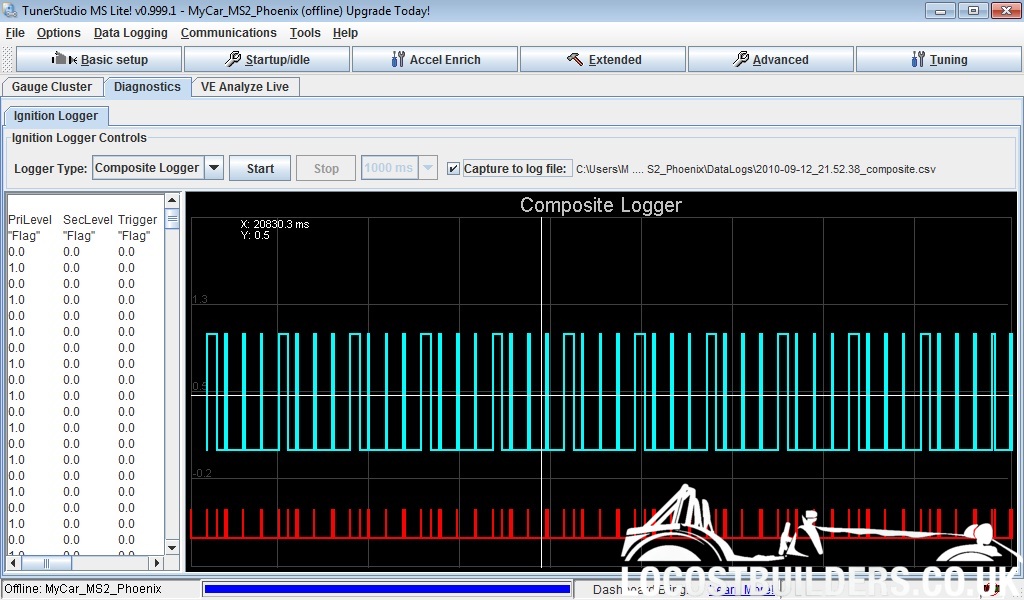
Here is some progress (image at top of 'scope screen).


the bottom trace shows the signals from the VR (variable reluctance) sensor.

The top trace is the output from the electronic pre-filter that I have built. I am pretty pleased with this, as the MS2 can detect edges in this signal that are both positive and negative, and hence I am in a good position for the software to deal with this. Note also that the long tooth is about 10x the length of the short tooth, so it is pretty definitive.

Here is the output when I log the teeth using the MegaTuneStudio software.


Now I just need to build a wheel decoder. My first version didn't work, but I found a small (but critical) bug in this, so I am optimistic that I might be able to get the engine to fire tonight.

Wednesday, 18 August 2010

Starting troubles

Ever since I have installed the Ms2 board I have had some problems starting the engine.


The characteristics are that if it doesn't start straight off, then it requires a bit of cranking. Sometime it hicups a bit. Once it kicks then heavy application of the throttle gets it going, but it isn't so nice. The battery is excellent, so that isn't the problem.

Not sure why, but the Ms2 has loads of nice tools for investigating this stuff. It seems (from the msextra forum) that the Ms2 is cleverer but consequently more temperamental.

I logged the trigger wheel which was interesting. Basically it is a 11 tooth wheel, one tooth every 30deg and one missing (a so called 12-1). This runs from the crankshaft (not the camshaft, which is why I run wasted spark ignition).

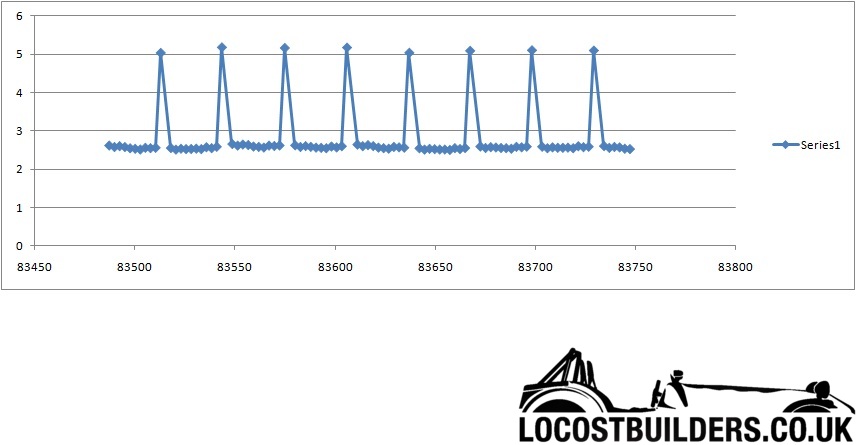
When running the time between teeth look like this:


This is exactly right, as the long gap is after the missing tooth, and all the other teeth are the same length. This works perfectly with the MS as it is looking for a gap that is more than 1.5x the length of the previous gaps, and then the gap after this long (missing tooth) gap must be 75% of the long gap. All syncs up nicely and everyone is happy.


But, what does it look like whilst cranking?


As you can see when it is cranking the gap between teeth varies through time. This is all to do with the forces required to compress the gas in the cylinders. Note there are a couple of things, firstly you can see the 4-stroke nature of the engine as alternate crank rotations have different profiles. I think this is because I have different compression on the frontmost cylinder, which results in the engine running a bit faster at that point.

Note also later on how the sync is lost (sync is the blue curve along the bottom, 1=synced, 0=no sync) after the engine fires. In this case the long gap is still seen but the gap after it is not.

The problems are due to the low inertia of this engine, the small number of teeth, and the high and variable compression. I already knew that I needed an engine rebuild, but here is more evidence.


Incidentally I ran a compression test.
12 16 10 12 (where 12 is the one that was previously down at 8). I don't know what is going on but I was already planning an engine rebuild so its not a big deal.

Tuesday, 20 July 2010

MS2 upgrade

I upgraded the chip in my megasquirt from MS1 to MS2.

It is amazing what the programmers managed to get out of the MS1 chip, it was designed to run fuel injection, but with the megasquirt extra code, it runs ignition and fuel injection, this means that the timing precision required is around 100x more challenging (i.e. instead of a squirt or several per revolution, ignition requires precision of a degree or so per revolution).

I had been running into the limits of the MS1 chip for a while. It couldn't keep up with my 36-1 trigger wheel, so I converted the wheel into a 12-1 and it was fine, although sometimes the rpm went a bit funny at 10500rpm (perhaps the rev limit coming in early, not sure). Additionally I was limited with acceleration enrichment (you can do MAP or TPS based with MS1, but with MS2 you can blend the two). Next the TPS resolution was a bit of a problem with MS1, so I added a parallel resistor to improve the resolution at closed throttle positions. Finally, when I changed to secondary injection, then it was not possible to gradually ramp in the secondaries while the primaries ramp down. All in all it was time for a change.

So, Ms2 comes as a daughter card, which replaces the chip on the megasquirt board. You have to be careful to follow the instructions to the letter to avoid blowing it up. The megasquirt maps all need re-writing, but fundamentally much of this is copying from the old maps and settings.

After some messing around I managed to get the car running, and preliminary results suggest it to be much smoother and nicer. I think the ignition timing wasn't so good with the MS1, and injector timing is much better with the new chip.

Going for a 10minute drive sorted out the fueling map, so I am very pleased with it. Even on the tuning run where it was overfueling like mad (AFR of 10.5-11.0 when it should be 13 or so) it went very nicely. So I am very optimistic of how this is going to turn out.

Actually everything about it is awesome with no ned to reflash the memory to do things like updating the sensor scaling values (temp for example).

No pictures, sorry.

Thursday, 15 July 2010

Civic injectors do fit


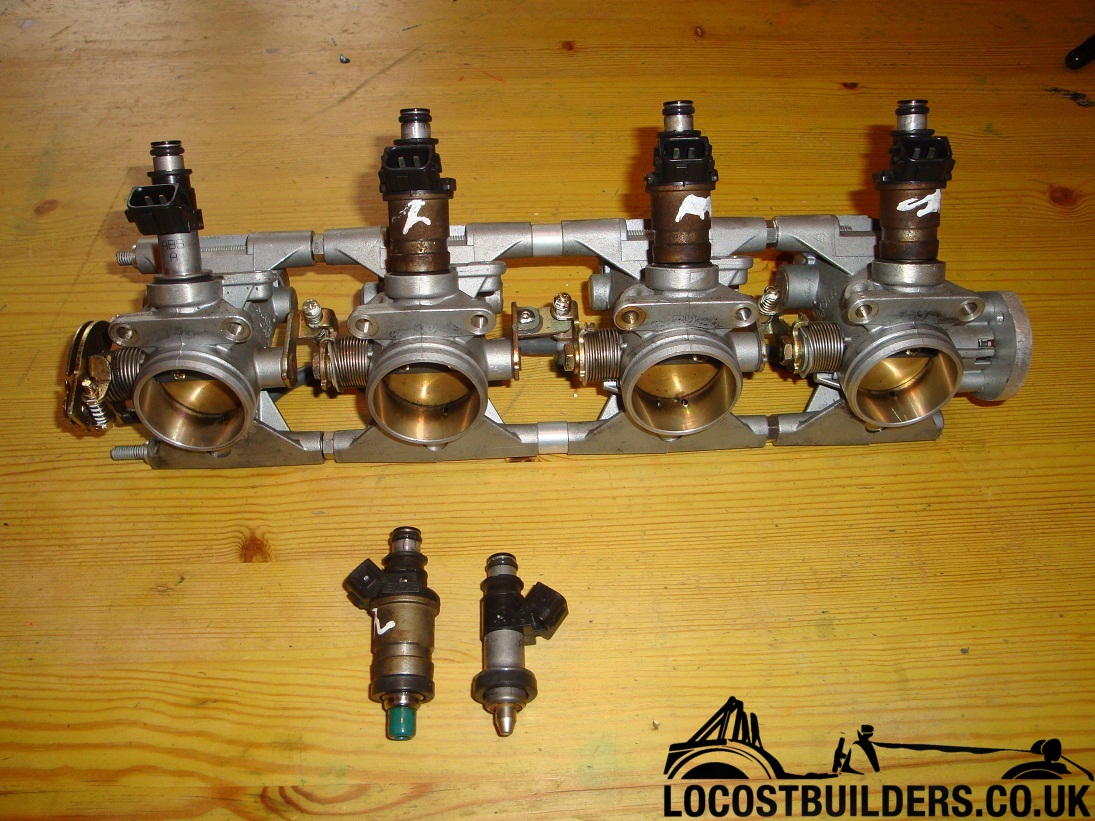
Just a quick photo of the GSXR and Honda Civic injectors. Only differences are the civic ones are 7mm longer, and the green tip is a bit larger. For the gsxr600 bodies the hole was large enough, for the gsxr1000 ones I needed to drill it out (annoying as an off the car job). The rubber gaskets are identical between the two injectors.

Codes on the injectors are 4109, and these are injectors from a D16Y7 civic coupe from 1998. Flow rate is 190cc/min, and opening times are 0.80ms with a 0.20ms/V sensitivity (according to www.injector-rehab.com), some claim flow of 180cc/min, all flow rates at 3ATM 43.9psi, which is something of a Suzuki/Honda standard.

Dull stuff, except if this is what you need to know!

I have a follower!!!

Welcome, Mr Ellershaw,

Never had a follower before, feels like a religious moment.

Tuesday, 13 July 2010

De-stiffening the ARB; grinding, filing, sanding

I've been trying to workout what is going on with my anti-roll bar.

I put it onto the front of the car, and it certainly helped to make the car more stable in the corners. But, it gave me dreadful wear on the front outside tyre.

So, I hit the books to try to work out what was wrong.

ARB stiffness is a simple calculation,
Effectively the stiffness depends on the material properties, diameter to the power 4 (for hollow bars you do outer diam^4 - inner diam^4), divided by the length.

Then the effect that this has on the wheels can be determined. This has two parts, one the length of the arms on the ARB, and then the motion of the wheel versus the motion of the end of the arm. By this I mean, if the arm is short then it twists the ARB a lot for a small motion of the suspension. Conversely if the end of the arm is far from the wheel then the ARB will twist less than if the ARB is actually at the wheel.

The above arm and wheel motion ratio effects come in to the second power (once for the leverage effect which gives reduced force, and once for the fact that the angle is wound up less quickly and so it gets stiffer slower).

I'm not sure that explanation will help anyone, but who knows.

My bar is 16mm diameter and 400mm long and steel, with 5inch arms. Various calculations indicated that this was around 3times stiffer than ideal (determining ideal is the most difficult thing, but if you have a bar that is stiffer than everyone elses, and some of the everyone elses are winning races, then it means it is too stiff).

Welding ARB's gets a mixed reception as a method (mine is welded) so I didn't fancy making a new bar (if I did then I would use 2mm thing CDS tube of 1/2inch diameter, and get the ends mandrel bent, maybe bend them myself cold). So I decided to reduce the outer diameter of my bar.

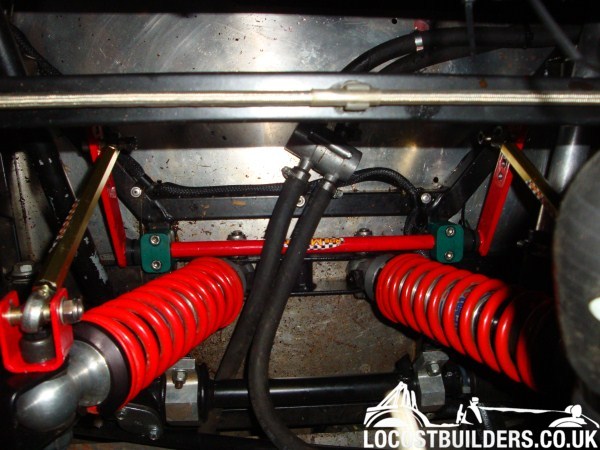
Lots of grinding, filing, and sanding later I went from this red thing;


To this silver thing;


Going for a drive it felt like there was more flex at the front, but this will only come in for "on the limit" handling, which isn't appropriate on the road. The original bar had a stiffness of around 400lbs/in whereas the front springs are rated at 175lbs/inch, so it was like a solid front axle. The revised bar is more like 180lbs/inch. Exact calcs are more difficult, because there is a 70mm section of 16mm, then a 330mm section of bar that is between 12.5 and 13mm. (the calculation is to determine the stiffness of each section and then combine them as (1/((1/Q1) + (1/Q2))) the same as for parallel resistors.

Some software that I received from Tim Hoverd indicates that I should go softer still (maybe 120lbs/inch, although he does have stiffer springs on the front than I do).

Anyway, hopefully it is a move in the right direction.